Carbon offsetting in city climate action: role, determinants and characteristics


Many cities around the world have developed emission reduction plans but vary in how they intend to meet targets. Some cities incorporate carbon offsetting to manage residual emissions, that is carbon removal or avoided emissions from elsewhere to compensate for emissions that are technologically or economically infeasible to abate. So far, little previous research has looked into the use of offsetting by cities. Our research explored the role of offsetting in city plans as better understanding this approach can help inform future city climate policy.
We used both quantitative and qualitative approaches to explore the frequency, characteristics and role of offsetting in city climate action. First, we quantified how many cities globally include offsetting in their plan. We found that 363 cities globally with a population over 500,000 have a quantitative GHG reduction target; 86 of these include offsetting in their plan.
Next, we applied a statistical approach (random forest model) to explore what characteristics of cities and their targets are associated with offsetting. We found that larger cities, those with a higher per capita GDP, and those with more ambitious climate targets are more likely to offset.
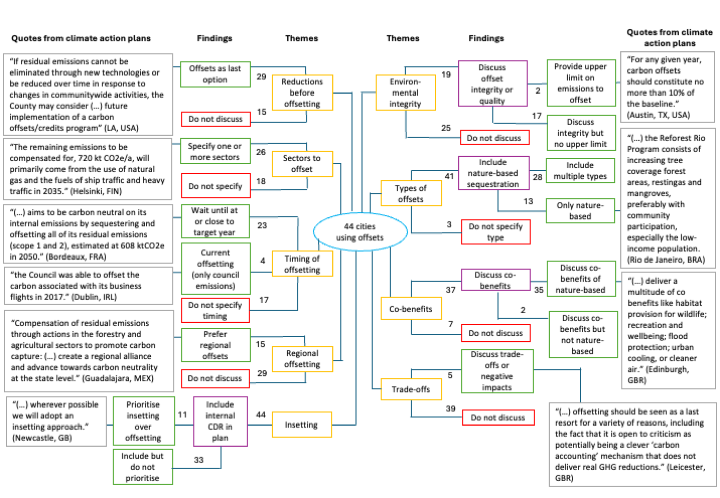
Finally, we conducted a text analysis of city documents from 44 cities that use or intend to use offsetting to explore how these cities conceptualise the use of offsets. Findings from this text analysis are presented in the interactive figure. The figure shows themes, key findings for each theme, and example quotes to illustrate the findings from analysing city climate action plans. We highlight the following findings from the figure with particular relevance to policy makers at both the city and national level as well as city organisations:
- Fewer than half the cities analysed discuss environmental integrity of offsets, and many lack detail on how to ensure integrity.
- Only five cities acknowledge the trade-offs or potential negative impacts of offsetting.
- The majority of cities are not currently offsetting emissions but plan to wait until at or close to their target year to begin offsetting.
Specifying concrete plans regarding offsetting and communicating these decisions is important for effectiveness and integrity of city climate action plans, knowledge sharing between cities, and planning for future offsetting.
For more information and detailed results of this research, please see our publication: https://www.tandfonline.com/doi/full/10.1080/14693062.2025.2499606